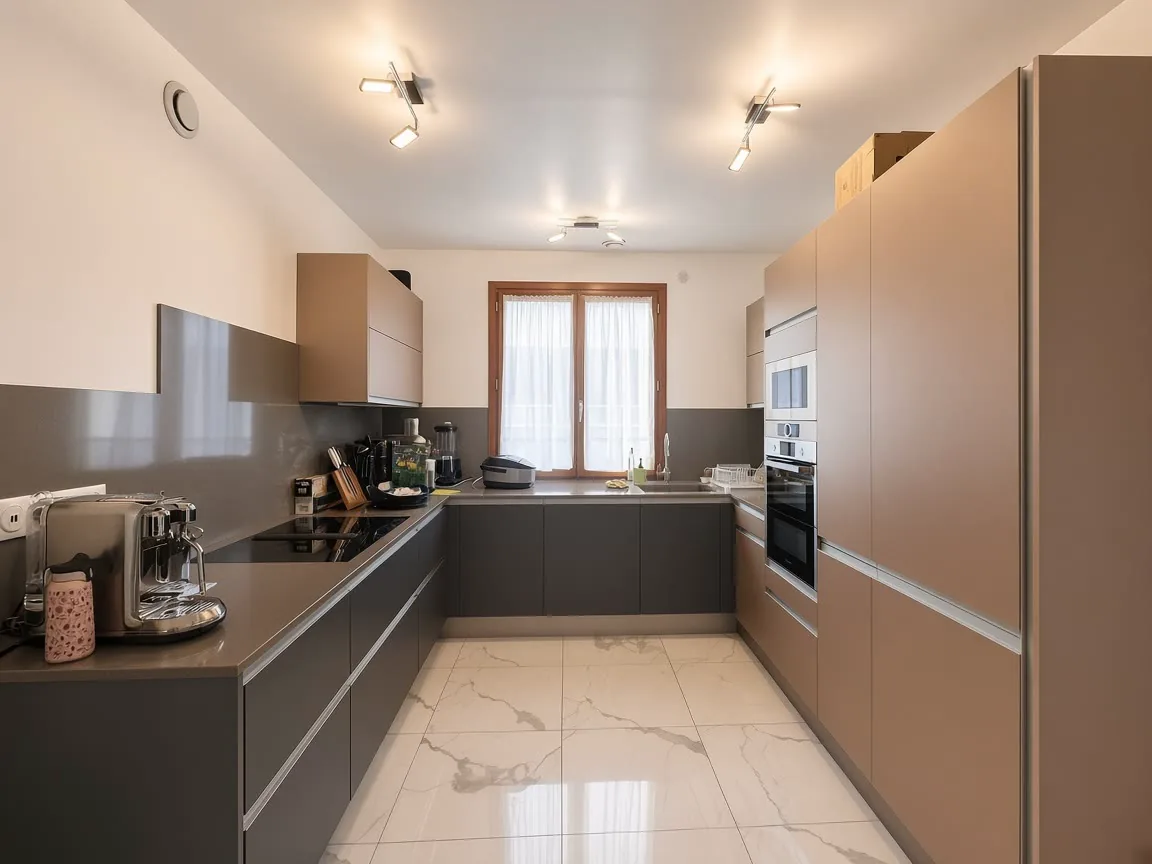
Start by looking at the carcasses
Open the doors and look at the bottom corners, especially under the sink and under the dishwasher. A swollen edge, a base that is lifting or a smell of damp all mean the carcass has taken on water, and a swollen carcass cannot be repaired. That is the one criterion that really decides between renovating and rebuilding.
Then check they are still square: a door that rubs at the top but not the bottom can be a simple adjustment, but if several doors lean the same way, the run has moved.
What can change without touching the rest
These four items are independent of one another. You can do just one of them.
- Doors and drawer fronts: the most visible change to the room for the smallest intervention.
- The worktop: what ages fastest and is seen most, so often the best first euro spent.
- The splashback: quick to take off, and it changes the light in the room as much as the colour of the units.
- The hardware: soft-close hinges and full-extension runners transform daily use without changing the look at all.
What forces you back to zero
Changing the layout first: moving the sink or the hob touches the plumbing and the electrics, and at that point keeping the old carcasses no longer saves much.
Carcasses damaged by water, next. And a less obvious case: a kitchen built to dimensions that are no longer made in series. You are then back to bespoke doors anyway, and rebuilding the whole thing often costs the same.
The trap with new doors on standard carcasses
Replacing doors sounds simple, and it is when the carcasses come from a current range still in the catalogue. Once a kitchen is more than about ten years old, the dimension steps have moved and so have the hinge borings.
Making bespoke doors for old carcasses is still possible, and it is a good part of what we get asked for. You just need to know that the measuring is then done door by door, because nothing guarantees that two neighbouring doors are the same width.
When bespoke costs less than renovating
This happens more often than people expect. If the room forces many adaptations, if the standard carcasses already left gaps filled with end panels and plinths, and if the doors have to be made to size anyway, then you are paying for bespoke without getting a bespoke kitchen.
We say so when that is the case. An honest quote compares both routes rather than pricing the one you came in asking for.